In this lesson, one of my favorites from Exploring Algebra 1 with The Geometer's Sketchpad, students model expressions with dynamic algebra tiles, using the areas of the tiles to see the equivalence of expressions in factored and expanded form.
Welcome to Algebra Mazes, my new early algebra puzzle that shares DNA with my earlier creation, Sneaky Sums. Both Algebra Mazes and Sneaky Sums puzzles present you with a grid of shapes. Each shape represents a secret numerical value for you to deduce. Whereas Sneaky Sums puzzles were generated randomly, … Continue Reading ››
I must admit that I am addicted to triangle shearing problems . I've written about them before, and will be revisiting them soon in my City College geometry class. I mention this because several weeks ago, I encountered a problem in the LinkedIn feed of mathematics educator James Tanton that made … Continue Reading ››
I was doing some spring cleaning a few weeks ago and came across a stash of old files that were "extra" ideas that never made their way into our Dynamic Number curriculum project. One concept in particular caught my attention—a "scooting" tick mark. Unlike traditional tick marks that dutifully sit in … Continue Reading ››
Way back in 2014, I wrote a blog post titled Covering Your Bases that offered an interactive Web Sketchpad experience with various number bases. As I noted then, "There are certain topics in mathematics education not appropriate for polite discussion. Number bases other than 10 fit this category well, perhaps because of … Continue Reading ››
For the past eight years, I've been engaged in a project that is about as far from mathematics as one could imagine — coediting an English anthology of contemporary Turkish poetry with my good friend, Buğra Giritlioğlu, who is the founder of the queer publishing house obiçim yayınlar.
Longtime readers of this blog will know that I get more than just a little excited by devices—both mechanical and virtual—that draw conic sections. I've written about the conic section-drawing devices of the 17th-century Dutch mathematician Frans van Schooten as well as other methods of generating conics in a … Continue Reading ››
This blog post features a sliding ruler approach to modeling the addition and subtraction of integers. Rather than memorizing rules for solving problems like 9 + (–14) or -2-(-7), students can develop completely general methods that focus on conceptual understanding.
Below is a problem taken from Dietmar Küchemann's Algebradabra site.
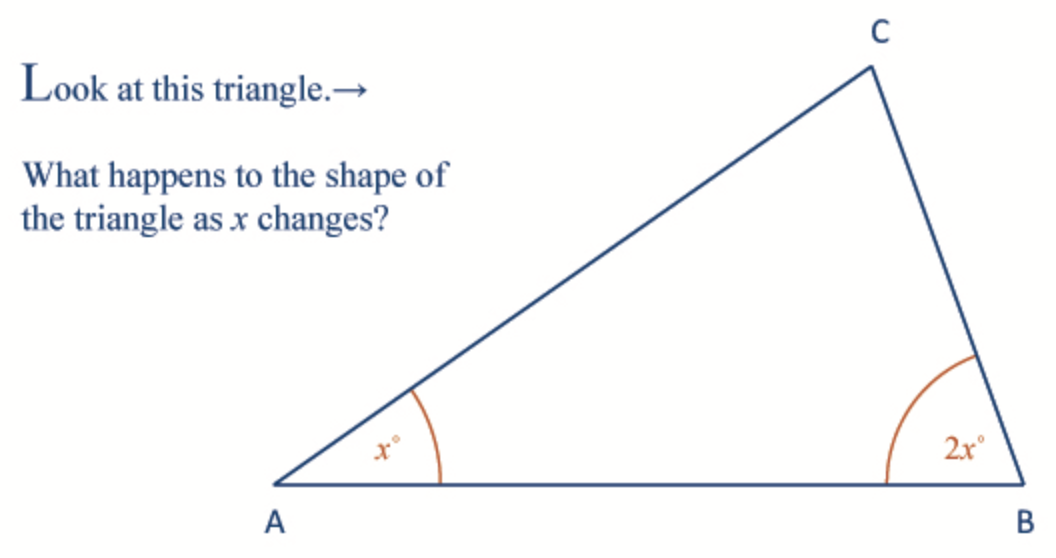
Many problems that mix geometry with algebra invariably shortchange the geometry. For example, the angles of a triangle might be labeled x, … Continue Reading ››
It’s a gripe I’ve shared before, but I’ll repeat it—the typical high school geometry approach to introducing transformations is boring. Fresh from learning the definition of a translation, reflection, rotation, or translation, students are whisked off to the safety of the coordinate plane and asked to explore the numerical effect of reflecting a … Continue Reading ››